Welcome to tales of my stitching life, home, family and friends.

Tuesday, April 3, 2012

Looking over Lake Hawea

Life can’t get much better than this.  Here we are, sitting outside the caravan in the brilliant sunshine.  The view over Lake Hawea is breathtaking – we feel that we could well be in heaven!
DSCF0411 Looking from our camp site over Lake Hawea
It’s time to get on with my stitching, I decided, while I’ve been relaxing in the sun.  The herb cushion for my daughter is coming along slowly.  Now I’ve finished stitching the words in black, and the herb planter box in timber brown, I’m all ready to start on the various herbs, all in various colours of green. 
DSCF0414 Getting on with my stitching
The scenery in this part of New Zealand is amazing, the mountains and lakes are on such a grand scale.  We are enjoying our time here at Lake Hawea and will shortly be travelling over to the wild West Coast area.  If you are interested, please do pop over to our travel blog on
www.romanyrambler.blogspot.com   to catch up with our travels.

Saturday, March 31, 2012

I found a fellow quilter

qThe quilt on the office wall gave it away.  We were registering at a Motor Camp in Manapouri to stay for a couple of nights, and I could see a pretty little wall hanging.  “Are you a quilter?”, I asked hopefully.  “Yes”, was the reply, “Come over to the house and I’ll show you my quilts”.  Well, I didn’t need to be asked twice, I can tell you.
DSCF0218 Welcome to campers who come calling
Gloria told me about her recent wonderful three week trip to Houston and the Amish country.  She had a big bag full of fabrics, patterns and quilt pins she had bought.  She was particularly pleased with her purchases from Jinny Beyer’s stall at the Houston show.  Gloria has a dedicated quilt studio in her home, (lucky girl, I have to sew in the dining room), and told me that she usually works from quilt kits which she purchases overseas.  The beautiful butterfly quilt hanging on the wall was made from a kit and the technique is “fractured tile”.  It has the look of stained glass, but instead of using bias tape the many pieces are fused then stitched down. 
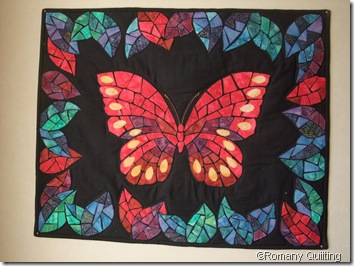
DSCF0224 Butterfly wall hanging
This was another pretty wall hanging made from a kit, featuring fuchsias.  I just love what a black background does to pretty colours to make them glow.
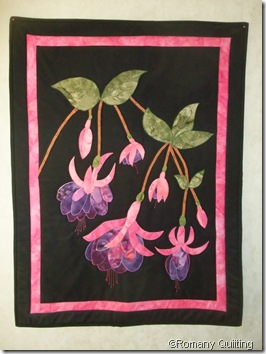
DSCF0225Fuchsia wall hanging
Like most quilters I know, Gloria likes to make bags too.  The fabric is a wonderful batik printed with North American wildlife.  That’s Gloria hiding, “don’t take my photo”, she pleaded.
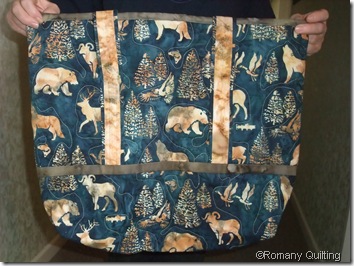
DSCF0226Batik Bag
The appliqué plane quilt was made for Gloria’s son, isn’t it stunning.
DSCF0230Aeroplane quilt
I rather liked this pussy cat bed quilt.  It was a “block of the month” and features twelve cats of various sorts and colours.  There is a lot of work in this quilt, with little pieced blocks in the setting squares too.
DSCF0231Pussy cat block of the month quilt
This is another family quilt, made for her daughter, and full of beautiful appliquéd roses, truly a work of art. The cream background sets off the lovely soft colours of the flowers and bows very nicely.
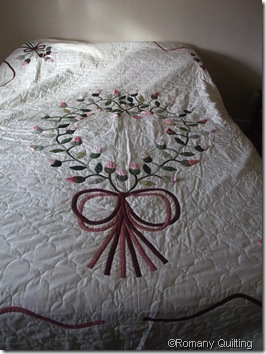
DSCF0232 Appliquéd quilt made for Gloria’s daughter
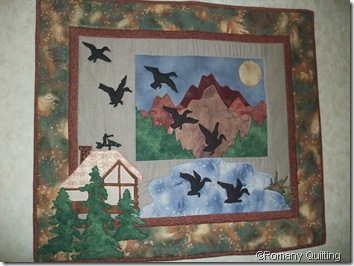
Then I noticed several wall hangings featuring silhouette shapes on the walls. Here are a couple of them.
DSCF0229 Is this “Easy Rider”?
DSCF0228Fall in the mountains, perhaps?
And to finish off my tour I was taken into the “littlest room” to see what was hanging behind the door.  It’s a toilet roll quilt, how very appropriate.
DSCF0234Toilet roll quilt in the loo
Many thanks to Gloria for showing me so many of her beautiful quilts.  Quilters are such generous people and I really appreciate her taking the time and trouble to show me all her wonderful work.  Here we are staying at the Manapouri Motor Home and Caravan Park, beautifully set out amongst lots of lovely trees, and a brand new ablution block.  We can certainly recommend this camp to fellow travellers, and Gloria and Selwyn made us most welcome.
DSCF0235   Parked at at Manapouri

Tuesday, March 27, 2012

Gorgeous Gowns from Gore

Gore is big on history, and the amazing Museum complexes houses two museums in the one building.  We enjoyed learning all about the illicit manufacture of whisky during the days of prohibition at the Hokonui Moonshine Museum – see our Travel Blog on www.romanyrambler.blogspot.com to read about this. 
I just loved checking out the adjacent Gore Historical Museum and the Genge Costume Gallery in particular.  There’s something about these beautiful colonial gowns, isn’t there?  The ones on display were even more special as each gown was accompanied by a wedding photo.  This silk wedding dress was made by the MacGibbons store in Gore in 1908 for the wedding of Grace Smith to William Crawford.
DSCF0111 1908 silk wedding dress
This pretty cream and blue dress was worn by Mrs Whytock who emigrated to New Zealand aboard the “Ben Lomond”.  She married shortly after arriving in September 1863 and settled in the district.
DSCF0113 1863 wedding gown brought out from England
Another beautiful old wedding gown, this one from 1876.  This was worn by Mary Shennan of Otago when she married William Thomson.
DSCF0115Wedding gown from 1876
This black lace “Mother of the Bride” gown from 1918 was worn by Mrs Johnston of Gore at the wedding of her daughter Hilda.
DSCF0119Mother of the bride gown from 1918
DSCF0110There was also a cabinet of beautiful lace collars in this gallery. 
These were such lovely clothes from yesteryear and the sort of thing that I just love to gaze at.  They were beautifully displayed in the gallery and the museum is a real credit to the township of Gore.

Sunday, March 25, 2012

Yes, I do enjoy doing the laundry!

Strange as it seems to some who know me, I rather enjoy doing the laundry.  A load of clean clothes flapping on the clothesline, smelling sweet from the sunshine, what could be nicer than that?  I still attend to the laundry regularly even though we are in the midst of our South Island Odyssey caravan trip.  Bliss is staying in a camp where there is a washing machine available, usually where you put a gold coin or two in the slot to start it up.  And if there is no machine available and we are on a powered site I can get my dinky little travelling washing machine out.  (This is a bit of a white elephant and is sometimes more trouble than it is worth).  The other alternative is to do some hand washing in my pink bucket.  But……..I now have a new tool in my laundry arsenal, a small sized clothesline.  This comes apart, and folds down to a small size to fit inside it’s own little carrier bag.  It is very light, so is no good in strong winds.  But on a nice fine day with a bit of gentle breeze, it works very well.  The weather looks a bit grey,  but the sun is starting to break through the clouds.

DSCF0132  My camping clothesline
A visit to the Gore Historical Museum had quite a selection of early washing machines, and as this is my area of expertise, they certainly attracted my interest.  I imagine that these machines were specially made by some enterprising manufacturer to make life easier for the colonial housewife.  These were manual machines and no doubt an awful lot of hard work was required to agitate the machines and turn the mangles.  The airing frame overhead would be a boon to get the never ending nappies dry on wet days.
DSCF0126 Washing machines at Gore Historical Museum
Well, I’m not quite sure how this next one works but I’m assured it is in fact an early washing machine although it looks rather like a rocket to me.  Robin took this photo as I’d walked right past and didn’t notice this one.
P3241593 Another early washing machine
Dare I say it?  I quite enjoy ironing as well!  But to be honest, I don’t have an iron in the caravan, I just fold up the clothes and put them away.  But once I get home, it will be a different story, the iron will be getting a workout then.  Wonder if I was a “washerwoman” in a former life?

Saturday, March 24, 2012

Costume Exhibition – with a Whale Flavour

“Have you any old quilts or textiles on show?”, I asked a helpful staff member at the Southland Museum in Invercargill.  “No”, was the reply, “but perhaps you would be interested in this?”, she said, as she shepherded Dot and me upstairs.  “The Blind Idealist’s Black Dog” was the intriguing name of an exhibition of costumes made by Jo Torr, inspired by a recent voyage to the Auckland Islands.   This is a sculptural interpretation based on the true story of the ill-fated attempt by the Enderby Whaling Company to establish a self sustaining settlement at Erebus Cove on the Auckland Islands in 1849.
DSCF0005Calico dress, printed and embroidered with whale motifs
This pretty white gown reflects the several weddings which took place over the years the settlers were struggling to make a living. 
DSCF0007 Wedding dress
DSCF0008Tanned seal skin used in the waistcoat and coat collar
DSCF0010Whale bone used in the corset, embroidered with whaling motifs  
These beautifully constructed costumes of the settler’s clothing highlight their expectations for their new life in an unknown land.  The 300 strong settlement was abandoned three years later.  The weather was too cold and wet to grow crops, and with the whaling and sealing industries in decline, there was little demand for the settlers boat building skills.

Friday, March 23, 2012

How could I refuse?

There I was in the wilds of Owaka on a sunny morning, doing a bit of hand washing in my pink bucket, when one of the other campers approached me.  This dark haired young man was a Swiss backpacker (with the most gorgeous dark eyes), and he had a problem.  It seemed that he had ripped the stitching along the zipper of his sleeping bag.  The wife of the camp owner had loaned him her sewing box, but he was at a loss to what to do next.  I had a look and saw what the problem was.  “Mmm”, I said, “this really needs to be repaired on a sewing machine, as there were several layers involved.  Perhaps when you move on you can find someone in a town who does repairs?” 
DSCF9875 Can you help me?
“Can I do it myself with this?”, he asked, holding up a needle threaded with white cotton.  White thread on a black sleeping bag, that wouldn’t do at all.  Before I could stop the words coming out of my mouth I found myself offering to stitch it for him, using black thread, of course.  I explained that it was only a temporary repair, and he would still need to get it fixed properly.  He was such a nice young man, how could I refuse?  I must have reminded him of his granny back home, I think.
DSCF9874 My good deed for the day

Check out our South Island Caravan trip on our Travel Blog

www.romanyrambler.blogspot.com


Thursday, March 22, 2012

Tea Pots and Quilts at Owaka

For such a tiny settlement in the Catlins, Owaka has a lot happening.  The sign for “Teapot Land” stopped us in our tracks, we parked the car and hurried over the road.  I spotted a cute little tea pot quilt hanging in the window of the house, with appliquéd tea pots decorated with buttons sitting on little lace doilies. 
DSCF9876 Teapot Land quilt
Teapots were everywhere, and a sign by the donation box invited us to take photos.  There were huge ones, tiny ones, enamel pots, and a big stack of stainless steel pots piled on top of each other in a stack.   There was also a collection of black and white crockery pots all in the shape of cows.  
P3181420Some of the pots at Teapot Land
Pretty white doves had their own special teapot dovecote to roost in, the base of which was hung with even more pots.  I imagine this collection started small, then grew and grew like Topsy, with friends and neighbours bringing in more and more tea pots to add to the collection.  
DSCF9880Tea pot Dovecote
Just around the corner in the Information Centre I came across a wonderful selection of New Zealand inspired quilts for sale.  These were the work of local quilt artist Corale Willocks who discovered patchwork 15 years ago.  Several years later Corale purchased an embroidery machine, and likes to combine both patchwork, embroidery, and appliqué.  She loves to make quilts with a Catlins or New Zealand flavour.
DSCF9883
DSCF9884 
DSCF9885 Some of Corale’s quilts
It is clear that Corale’s love for the environment shines through all her work, it was such a delight to see her lovely quilts.